
The Generalissimo
History on Horseback

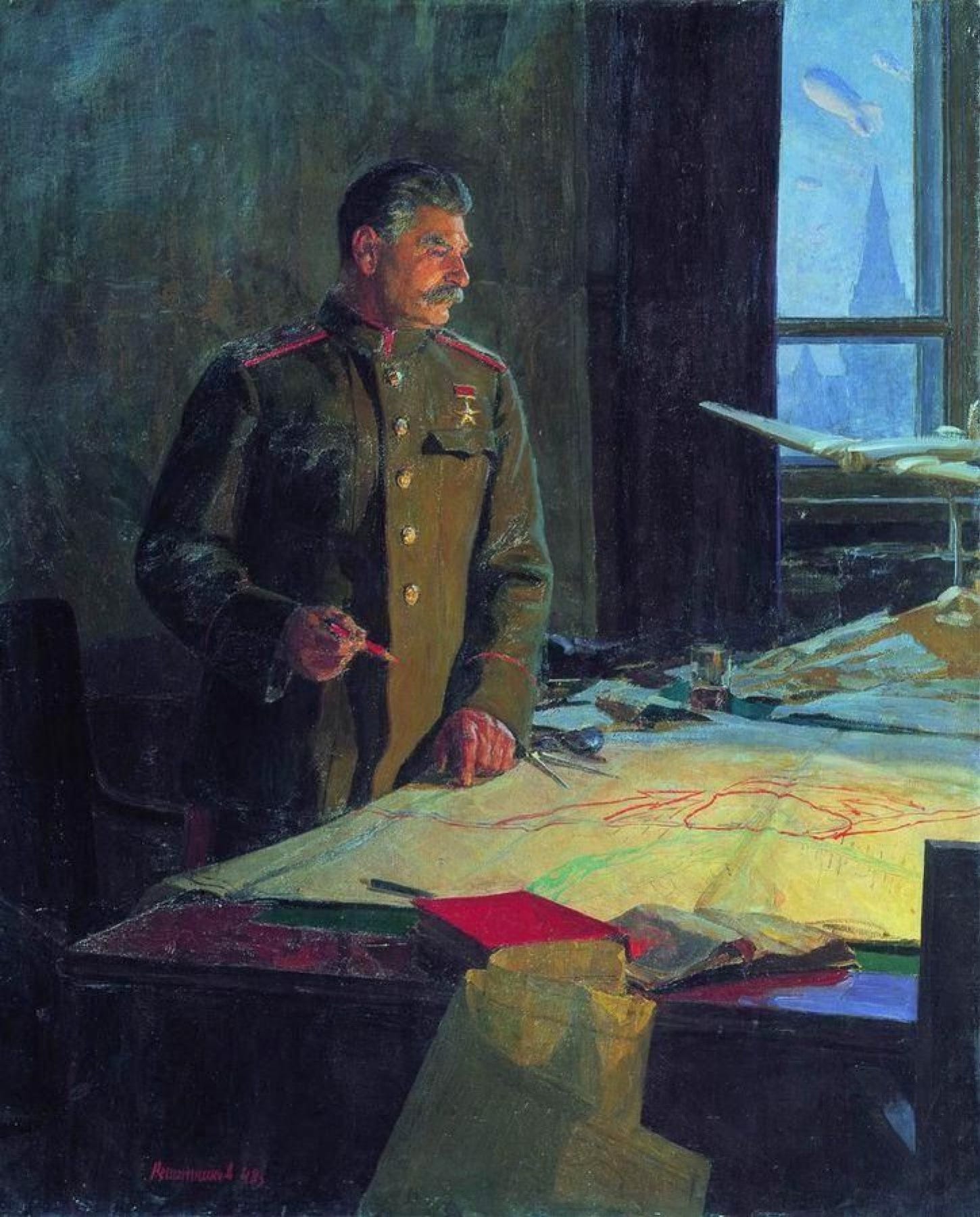
One of the most striking arguments in Trotsky’s critique of Stalinism is his repeated invocation of Napoleon Bonaparte as a historical analogue for Stalin. In Trotsky’s biting critique, he argued that both figures betrayed the ideals of their respective revolutions, ushering in an era of authoritarian consolidation that marked the exhaustion of revolutionary politics in their respective eras. Trotsky (1935) remarked that “in their manner of living, their interests and psychology, the present-day Soviet functionaries differ no less from the revolutionary Bolsheviks than the generals and prefects of Napoleon differed from the revolutionary Jacobins.” This analogy is problematic for a number of reasons, and is largely untenable on evidentiary grounds, collapsing historically distinct phenomena into a single framework that was politically useful for Trotsky at the time. However, this is not to say there are no similarities. Stalin and Napoleon are familiar insofar as they belong to the broad category of individuals who exerted an outsized influence on the course of history, but, following Plekhanov’s reading of the individual in history, they did so not as autonomous architects of events, but as men whose particular qualities happened to meet the particular demands their epochs had already placed before them.
Trotsky denies any exceptional qualities as a leader in Stalin, essentially arguing they are similar only in their shared betrayal of revolutionary ideals, while insisting that Stalin lacks any of the redeeming capacities, such as the military prowess or world-historical significance, that made Napoleon such a notable historical figure. I will argue that Trotsky’s politically convenient reading of the Napoleon-Stalin connection was applied in reverse.
In a previous article, I argued, following van Ree and Fitzpatrick, that Stalin did not represent the exhaustion of the revolution, as he presided over a period in which revolutionary fervour reached its most hysterical peak under the Great Terror. Like the Jacobin Terror, this episode was defined by an excess of revolutionary energy, one turned inward with devastating consequences as the revolution consumed its own adherents. In another article, I addressed the empirical issues with Trotsky's “Bonapartism” theory as a conceptual framework for making sense of Stalinism, given that, following Marx, Trotsky had conceived of Bonapartism as a class stalemate, a balance of forces involving two antagonistic classes in deadlock, which enabled the state to function as a mediating ruler with relative autonomy. Trotsky tried to apply the concept of a class stalemate to the USSR, arguing that kulaks and other bourgeois exploiters had pushed Stalin into passivity, thereby establishing a class stalemate with the Soviet proletariat. Of course, historical research on the Stalin era by specialists has completely discredited the notion that Stalin was too passive and in fact reveals the opposite problem: that his unrelenting and brutal campaigns of repression, including collectivization and NKVD “sweeps,” were too extreme and totalizing.
As it relates to the sequencing of revolution, Napoleon and Stalin were not analogous. There is no individual that can be considered a clean one-to-one analogue with Stalin from the French Revolution, but it would be more credible to argue that Stalin was akin to a Robespierre type figure who somehow held on to power and was able to institutionalize his revolutionary ideology in France. This would have necessarily entailed a degree of stabilization and conservatism inherent to state-building, but likely would not have gone as far as Napoleon in accommodating reactionary sentiment. No post-revolutionary state in history has been able to indefinitely sustain the utopian energy of the peak of that revolution; that will invariably dissipate, and it falls to the revolutionaries to translate their gains into durable political and economic institutions. This, however, does not mean that comparisons between Stalin and Napoleon are entirely without merit. Rather, Trotsky went about the comparison in the wrong way.
Trotsky (1935) had written, “there is no need to ascribe to Stalin the traits of Napoleon I; whenever the social conditions demand it, Bonapartism can consolidate itself around axes of the most diverse caliber,” implying that Napoleon, despite being a traitor to Jacobin ideals, was a man of high calibre, presumably due to his exceptional military and political capacities which led him to decisively shape an entire epoch. For Trotsky, Stalin and Napoleon may have occupied a similar structural role in their relation to the revolution, but he was clear that such analogous political forms were not dependent on the particular greatness of the individual in question. After all, for Trotsky, Stalin, unlike Napoleon, was an utter mediocrity, a provincial bureaucrat without any intellectual depth or organic connection to the working class. Despite the criticism levelled at Napoleon by Marxists over the years, they could not deny that he was a brilliant military and political figure. Trotsky would never concede that a similar characterization could be applicable to his most hated opponent.
Recent developments in historical research, with leading military scholars working closely with the archives, have seen a number of historians begrudgingly acknowledge that Stalin was an indispensable military leader whose decision-making was a major contributing factor to Soviet victory over Nazism. In this sense, Stalin arguably shared some of the qualities of “greatness” evidenced by Napoleon. Benjamin Schwarz (2007), surveying new developments in Second World War historiography for The Atlantic, writes:
But the new accounts—which even draw on transcripts of telephone and telegraphic conversations with his front-line generals—all go further than that, and put Stalin at the center of the Soviets’ awesome military achievement.
For instance, military historian Norman Davies makes clear that he is hardly a fan of the ruthless dictator, but he follows the evidence where it leads, observing that Stalin had endured a “calamity of indescribable proportions,” and that “the victory of 1945 in Europe was above all his” (Davies 2006, 425). For Shcwarz (2007), “Davies’s conclusion, that the victory was Stalin’s, would seem inarguable.” Alfred Rieber, in what is perhaps the most exhaustive scholarly examination of Stalin’s wartime leadership to date, Stalin as Warlord (2022, 268), writes that Stalin’s leadership, “steady, ruthless, tireless, and remarkably flexible — given the pre-war evidence, was a major factor in winning the war.” A popular misconception is that the USSR had won the war despite Stalin’s leadership and not, at least in part, because of it, a notion that seems to be based on understandable moral revulsion with Stalin’s acts of repression rather than an objective analysis of his performance as a military leader. In reality, it makes little sense to believe that a dictator with absolute power who retained close control over the levers of military power would have nothing to do with the outcomes of military decisions he had a key role in making. To a great extent, Stalin owns both Soviet victories and losses, and it was the former that carried through the victory over Nazism. Indeed, historian Geoffrey Roberts (2006, xi), in another magisterial assessment of Stalin’s war leadership, does not shy away from stating uncomfortable historical conclusions plainly:
Churchill, Hitler, Mussolini, Roosevelt – they were all replaceable as warlords, but not Stalin. In the context of the horrific war on the Eastern Front, Stalin was indispensable to the Soviet victory over Nazi Germany.
Along the same lines, Kershaw (2022, 238) writes, "However absurd the attempt was to claim sole credit for the victory, it is not easy to imagine that it could have been attained by a different leader." What this emerging consensus among military historians suggests, is that Stalin, despite his moral shortcomings, was an irreplaceable world-historical military leader who was uniquely qualified in leading the Soviet war effort to victory and defeating Hitler. Of course, all this occurred after Trotsky was killed on Stalin's orders, but the triumphant story of Stalinist war victory is difficult to reconcile with Trotsky's narrative of Stalin as a bumbling mediocrity. Indeed, perceptions of Stalin from other leaders and diplomats suggest an assured, confident, though ruthless leader:
[Stalin] was brief and incisive his comments, clear about his objectives, patient and inexorable in pursuing them. Brooke [Britain's head of the Army] considered that he had an outstanding military brain, and observed that in all his statements he never ones failed to appreciate all the implications of a situation with quick, unerring eye, and “in this respect he stood out compared with Roosevelt and Churchill.” The head of the U.S military mission in Moscow had noted that no one could failed to recognize “the qualities of greatness in the man.” (Grey 1979, 389)
In another relevant passage, Grey (1979, 387) writes:
