
The Red Jacobins
Terror in France and Russia

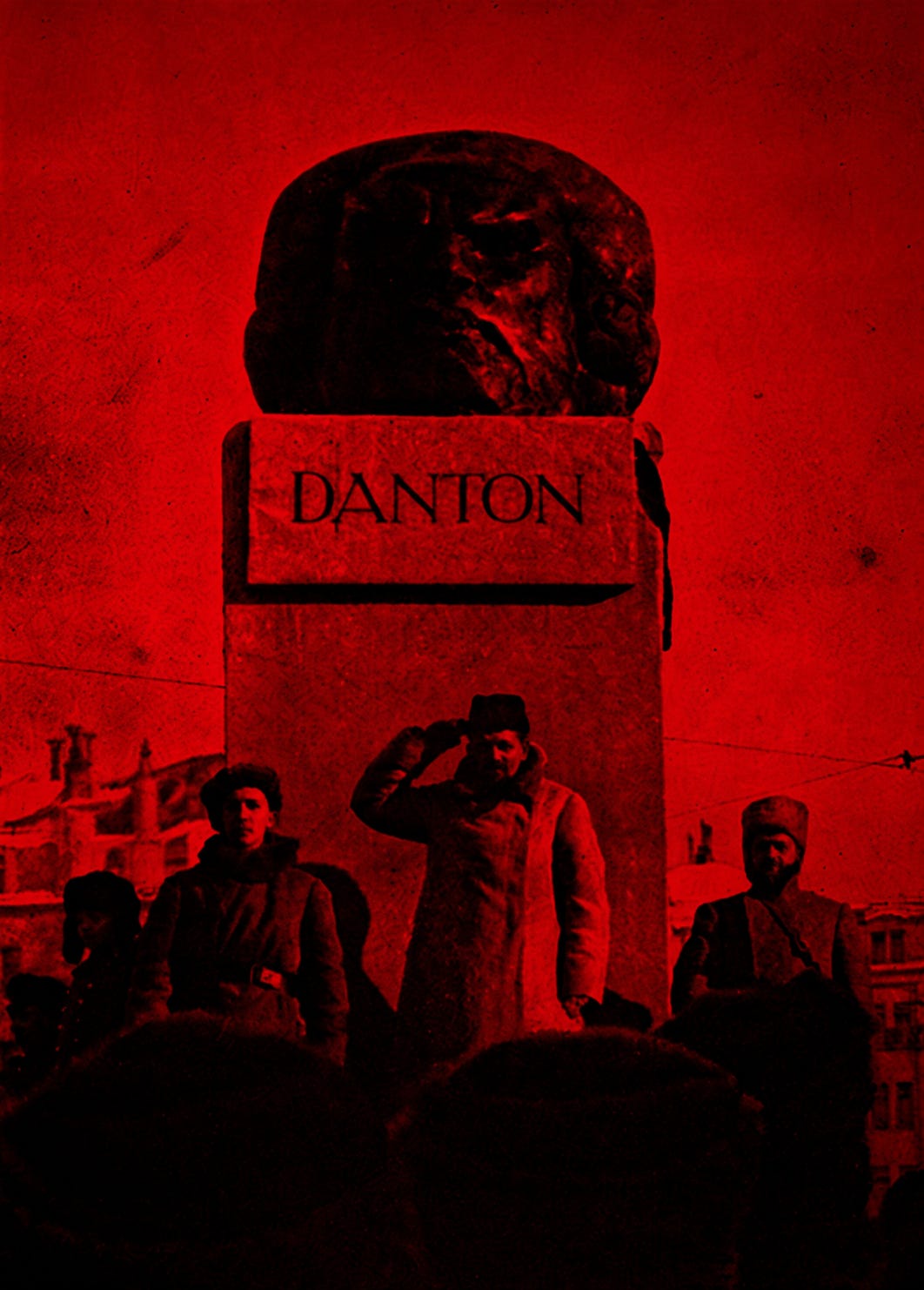
The political character of Stalinism remains one of the most vexing historical questions for the Left. Its violence, centralization of power, and cult of personality, among other facets, have naturally led large segments of the Left to want nothing to do with this episode of history. Beyond complete disassociation, it has become a political imperative to reject the idea that Stalinism had anything to do with Marxism or “real” Communism and instead position Stalin as a traitor to Lenin’s original cause who exploited the revolutionary moment to usurp power and establish a highly personalized dictatorship. For Trotsky (1933), a useful analogy for making sense of this betrayal was the French Revolution:
Why do we speak precisely of Thermidor? Because it is the best known and most complete historical example of a masked counter-revolution which still contains the outward forms and the ritual of the revolution, but which already changes the class content of the state.
In Trotsky’s framing, Stalin, like Napoleon before him, had led a counter-revolution under the guise of completing the revolution, and the various deficiencies of Stalinism, from the rejection of democracy to excessive police violence, were only proof that the Soviet leader had strayed greatly from the revolutionary path set out by Lenin and Trotsky. For Trotsky (1937), Stalin’s system had “nothing in common with Marxism” and was “in general foreign to any doctrine or system whatsoever … In keeping with its essential interests the caste of usurpers is hostile to any theory.”
While one can certainly criticize Stalin’s interpretation of Marxism, his violent policies and their outcomes, what is less convincing is the claim that Stalin did not genuinely believe in Marxism or that he was driven primarily by personal ambition or self-interest. Trotsky’s analysis was shaped by his own bitter rivalry with Stalin, and his assessment of the leader’s relation to Marxism is hardly the observation of an objective analyst. For a more dispassionate assessment, we must turn to academic historians working out of the archives who have closely studied Stalin’s political thought. Geoffrey Roberts’ study of Stalin’s library shows, for instance, how the Soviet leader was deeply invested in Marxist theory, with his collection of books consisting almost entirely of works in that tradition, and many heavily annotated in the margins. Stalin took Marxist ideas seriously his whole life, and they profoundly shaped how he approached his decisions as a leader. The fact that even in his final years he was publishing theoretical treatises on linguistics and political economy is demonstrative of an actor deeply submerged in Marxist thinking.
Stalin’s “unremitting pursuit of socialism and communism,” writes Roberts (2022, 209), was rooted in “deeply held beliefs.” Indeed, for Roberts (2023), “The most important thing to understand about Stalin is that he was an intellectual, driven by his Marxist ideas, a true believer in his communist ideology.” This is a common theme across the major works on Stalin. In Kotkin’s (2014, 462) monumental biography, he writes that “The fundamental fact about [Stalin] … was that he viewed the world through Marxism.” Khlevniuk (2015, 7) observes that “Ideological doctrines and prejudices were often decisive in Stalin’s life and actions... Underpinning Stalin’s worldview was an extreme anti-capitalism.” Likewise, Robert Service (2005, 300) is clear that “[Stalin] and the rest of the Politburo were Marxist believers.” For Sheila Fitzpatrick (2007), “Stalin was a Marxist, and the issue of the workers mattered to him.” Lastly, Ronald Suny (2022), author of a magisterial young Stalin biography, makes the important observation that the pursuit of power is not reducible to purely self-interested political manoeuvring; one can accumulate power in service of an ideological mission, as was the case for the Soviets: “Power was seldom simply about personal aggrandizement or advancement. Based on convictions derived from experience, history, and Marxism, power also served the commitment to a certain vision of the future.” Thus Stalin’s contentious political calculations and compromises should not be seen as irreconcilable with a broader revolutionary ideology, as his own political power became inseparable from the socialist system he built and the political values it projected. Indeed, the ability to successfully navigate power struggles and maneuver in the political arena is necessary for the revolutionary who is serious about seizing power and implementing their ideological agenda.
To suggest that Stalin had more or less abandoned Marxism strains credulity. But that still leaves us with a nagging, unanswered question. How could Stalinism, a system in Trotsky’s (1937) words “thoroughly permeated with police subjectivism” whose “practice is the empiricism of crude violence,” be reconciled with a revolutionary tradition that was supposed to be radically liberatory? Furthermore, even granting Stalin’s own deeply held Marxist convictions, it is worth asking whether the system he built could still very well constitute a fundamental departure from the tradition he claimed to uphold, distorting Marxism beyond recognition in its violent attempt to realize it. In the words of Shachtman (1946), was Stalin’s Marxism, regardless of his own intentions, “organically alien” to the Bolshevik spirit which engendered the October revolution?
Trotsky’s mistake is in assuming that excessive state violence and repression are somehow at odds with the spirit of revolution. He (1935) explains how the original Bolshevik revolutionary terror “has been completely supplanted by the cold blooded and venomous terror of the bureaucracy,” describing Stalin’s terror as a kind of bureaucratic consolidation. However, if the Jacobin terror is any indication, sweeping centrally directed violence, self-destructive paranoia, and the expunging of perceived impure elements are not aberrations of revolution, but in fact are among its most fundamental characteristics. Few would characterize Robespierre’s reign of terror, in which countless innocent people were executed on spurious charges, including his close allies, as a straightforwardly good thing; its exceptional brutality and fanatical character is noted by even Robespierre’s most sympathetic writers. Yet it would be incoherent to say that Robespierre “betrayed” the revolution, when his episode of terror in fact constituted an integral, yet tragic, sequence of the revolution itself. The violence did not stem from a departure from revolutionary zeal, but was a manifestation of its excess, consuming its makers through the unfolding of its own internal logic. To say the self-destruction of terror is “revolutionary,” is not to say it was justified, but that, despite its needless devastation, it still emerged as a part of a process of revolutionary upheaval. Under external and internal pressure, apocalyptic tendencies within an ideology of revolutionary transformation reach hysterical heights.
On these terms, Stalin’s purges and his cult of revolutionary purity may also be less a betrayal of the tradition Trotsky claimed to defend, and a distilled expression of its zeal. In this way, Stalin, rather than being a Bonapartist, can perhaps more credibly be described as the Red Robespierre. On this note, van Ree (2003) writes:
But if we are drawing historical parallels, did Stalinism not represent a twentieth-century “Thermidor” or a “Bonapartist” aberration rather than a Jacobin repeat performance? With his terrorist campaigns, Stalin followed in Robespierre’s footsteps. He consolidated the revolutionary dictatorship instead of undermining it. Ironically, especially the campaign of terror in the party’s ranks brought the Soviet system nearer to the Robespierre original than it had been under Lenin, when the revolution had not yet devoured its children. Stalin’s motives for the terror were also remarkably similar to Robespierre’s, namely to establish total, unconditional unity of the state and root out all alleged traitors to the nation. Contrary to what Trotskii believed, precisely the Stalinist terror proves that there was no “Thermidor” in the USSR.
On a similar note, Fitzpatrick (2008, 4) writes:
The fact that it was state terror initiated by Stalin does not disqualify it from being part of the Russian Revolution: after all, the Jacobin Terror of 1794 can be described in similar terms. Another important similarity between the two episodes is that in both cases the primary targets for destruction were revolutionaries. For dramatic reasons alone, the story of the Russian Revolution needs the Great Purges, just as the story of the French Revolution needs the Jacobin Terror.
Sheila Fitzpatrick makes the controversial move of including the Stalinist purges as an episode within the Russian Revolution. The Red Terror, with its violence largely directed outward against defined class enemies, is only one part of the paradigmatic sequence of revolutionary terror. Just as the Jacobin terror saw its violence close inwards, consuming its most faithful adherents, the Soviet terror followed the same course, though it took more time to get there. There was a 15-20 year gap separating the Leninist and Stalinist terror, but the revolutionary impulse of terror was only simmering beneath the surface, only to be reactivated by a confluence of external and internal political factors. Stalin, then, “completed” the terror, following in Robespierre’s footsteps by rooting out all perceived opposition, which also encompassed close allies. The French and Russian Revolutions are parallel stories. Indeed, Fitzpatrick and van Ree are correct to note that the notion of Thermidorian disillusionment does not coherently map onto the Stalin era in the way Trotsky supposed, as Stalinist spasms of mass upheaval and terror reveal a fanatical escalation rather than a relaxation of revolutionary energies.
This was not a surgical removal of enemies by a totalising bureaucratic apparatus. Caught up in revolutionary fervour, Soviet officialdom sought to destroy perceived enemies in a war which they themselves genuinely understood as being waged on the defensive. Indeed, Getty (1987, 206) writes that it was really not “a petrified bureaucracy stamping out dissent and annihilating old revolutionary radicals. In fact, it may have been just the opposite … a radical, even hysterical, reaction to bureaucracy.” The state was perceived as being riddled with enemies, and thus the terror was a process of “cleaning house.” While for Trotsky and Stalin’s critics, to kill one’s friend and comrade, to put no individual above the test of party loyalty, was an act of betrayal, for its participants it was unwavering revolutionary fidelity to the cause. Loyalty to the general will of the party was placed above any personal attachment or feeling. In their subjective worldview, to kill one’s (former) comrade was to cut away the rotting part of the fruit, an act not of treachery but of necessity, performed in the service of the unitary organism of the Party which embodied the revolution itself.
