
Misreading Stalinism
Trotsky and the Myth of "Soviet Bonapartism"

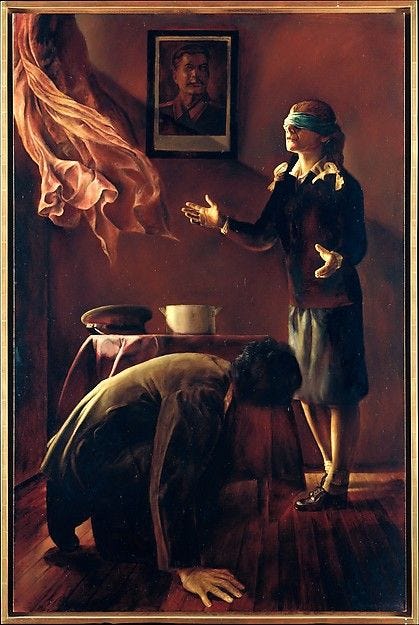
The Trotskyist analysis of Stalinism endures as the most influential and politically resonant critique of the Soviet leader, producing a robust tradition in which anti-bureaucratism and democratic political organization constitute key pillars. For activists of the Trotskyist left, any progressive movement aspiring to advance socialism in the 21st century must distinguish itself from what it perceives as the failed authoritarian experiments of the past. The intention to correct those failures is surely welcome, yet any political program grounding itself in historical critique should take care to get the history right.
The focus of this writing will be the views of Trotsky himself, particularly his understanding of the Stalinist state as a Bonapartist bureaucratic regime. These views have informed so much of the left’s understanding of Stalinism, and their foundations are deserving of closer scrutiny. Though it should be noted that Trotsky’s critique of Bonapartism was never fully consistent; it evolved throughout his political career and often in response to ongoing developments. These critiques were shaped by his dwindling political fortunes, certain ideological assumptions, and, by nature of exile, a limited view into the actual machinery of the Soviet state. The result was a conceptual framework built on faulty foundations.
Trotsky’s conception of Bonapartism was always central to his interpretation of Stalinism as a “Thermidor,” a counter-revolution betraying the original Bolshevik thrust of the Russian Revolution carried forward by Lenin and himself. This article stands on its own, but can be read as a sequel to my previous two pieces on the French Revolution and Stalinism (Part 1: Red Jacobins and Part 2: The Red Robespierre), which argued that historical Stalinism had more in common with Jacobin terror than with Napoleon’s Thermidorian reversal of the revolution’s radical phase.
Trotsky drew on the concept of Bonapartism as previously employed by Marx, Engels, and Lenin, adapting it to the Soviet experience. For Trotsky, Bonapartism was a political category derived from the historical experience of Napoleon Bonaparte’s rise to power in the aftermath of the French Revolution, though not reducible to Napoleon I as a historical figure. It described a situation in which the state acquires a degree of autonomy from society, elevating itself above competing social forces. As Trotsky (1937) wrote:
Bonapartism, enters the scene in those moments of history when the sharp struggle of two camps raises the state power, so to speak, above the nation, and guarantees it, in appearance, a complete independence of classes — in reality, only the freedom necessary for a defense of the privileged
Within this framework, Trotsky interpreted Stalin as a modern Bonapartist figure. Much as Napoleon had consolidated the social gains of the French Revolution while curtailing its democratic and popular dimensions, Stalin was seen as presiding over a bureaucratic counter-revolution carried out in the name of the October Revolution. In an excellent study on Trotsky’s developing notion of Soviet bureaucracy, Twiss (2014, 316) describes the nature of this Trotskyist comparative analysis between Stalin and Napoleon Bonaparte:
On the basis of both the general deterioration of the regime and the growing concentration of power in Stalin’s hands, in early 1930 Trotsky began to compare the party regime to the highly autonomous and authoritarian regimes of Napoleon and Louis-Napoleon Bonaparte. Thus, in February 1930 he asserted that the methods used against the party right represented ‘a new stage in the process of the Bonapartist degeneration of the party regime’ In his draft theses on the Russian question in April 1931, he denounced the ‘Bonapartist system of administering the party.’
There are two major issues with Trotsky's theorization that will be addressed in the following writing. The first concerns Bonapartism as an analytical category and whether, as Trotsky (re-)constructs it, it can be coherently applied to the Soviet experience. The framework faces serious difficulties here, as the political-economic context of 1930s USSR is difficult to reconcile with Trotsky's core assumptions. Building on his Marxist predecessors, Trotsky developed the Bonapartist category in novel ways, but in doing so distorted the empirical reality to make the model fit. The second issue is Trotsky's comparison of Napoleon and Stalin, one which is contradicted by a great deal of evidence demonstrating how fundamentally different these two figures were, both as individuals, in the nature of the regimes they presided over, and in the historical roles each played. That will be the focus of the second part of this article.
Bonapartism
Engels, building on Marx, described Bonapartism as a kind of class stalemate, in which two warring classes prove unable to decisively defeat one another, allowing the state to rise above both factions and govern with a degree of independence, playing one side off against the other. Both Engels and Marx identified earlier historical instances of this phenomenon, with Napoleon III serving as its paradigmatic modern expression, concentrating state power amid the unresolved conflict between the bourgeoisie and the lower classes.
It is not entirely surprising that Trotsky saw Stalin as a Bonapartist figure alien to the working class, especially considering that Trotsky, as a founding figure of the revolution, was outmaneuvered and pushed out of his own Bolshevik government, a defeat he could only make sense of in terms of counter-revolutionary treachery and connivance. Like Napoleon, who was seen by many on the Marxist left as having betrayed the gains of the French Revolution, Stalin, according to Trotsky, had similarly betrayed October, rising to power on the back of bureaucratic reaction and elevating the interests of a privileged caste above those of the international working class. The broad, superficial commonalities between the alleged revolutionary usurpers had no doubt encouraged Trotsky to draw deeper connections between the two political actors across time through the framing of Bonapartism. For Trotsky, Stalin’s rise was similarly enabled by a balance of class forces, producing a degree of state autonomy in which the bureaucracy could govern semi-independently.
What were the two opposing class forces in Stalin’s USSR? Twiss (2014, 168) describes how, according to Trotsky, “bourgeois elements had grown in size and economic influence and had become more self-confident.” Trotsky had argued that the NEP, necessary as it was, still “revived forces hostile to socialism’, resurrecting a layer of peasant exploiters (the kulaks) and a layer involved in ‘trading capital’ that dreamed of a restoration of capitalism” (Twiss 2014, 169-170). This dimension of Trotsky’s critique deserves more emphasis than it typically receives. Despite the popular characterization of Trotsky as the humane alternative to Stalin, Trotsky in some respects shared the same ideological impulses that ultimately drove Stalinist mass repression. In his reading, Stalin had permitted right-wing elements in the country-side to grow bolder in their anti-Soviet activity; here, the Stalinists were not doing enough to combat the kulaks! These reactionary elements had fought the proletariat to a standstill, Trotsky argued, further entrenching the Stalinist bureaucracy’s grip on power. The opposing class forces in the Stalinist USSR thus comprised reactionary elements in the countryside on one side, and the Soviet proletariat on the other.
In reality, however, when it came to the de-kulakization drive, there was no Soviet figure more ideologically committed to defeating the kulaks, going so far as to “liquidate” them as a class, an intensification of existing tendencies within Bolshevism that understood the repressive destruction of kulakdom in its entirety as necessary to realizing socialist construction. On this, Kotkin (2014, 739) writes that “If Stalin had died, the likelihood of coerced wholesale collectivization — the only kind — would have been near zero,” adding that Stalin “felt the survival of the revolution was at stake and that he had the political room to act.” Stalin went above and beyond his peers in pursuing a path of total liquidation. Indeed, Lewin (1966, 210) writes that:
