
Stalinism from Below
The Anti-Napoleon

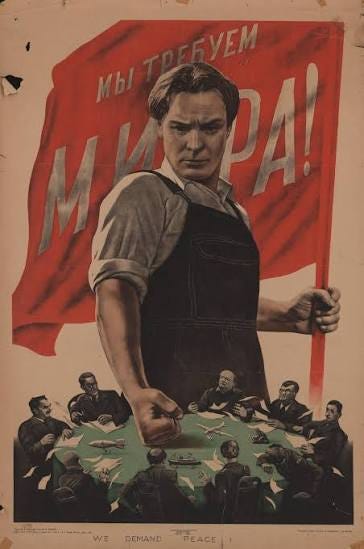
Few historians would disagree that Stalin was a dictator whose authority ultimately depended, to a large degree, on the concentration of personalized power. Yet this emphasis on the centralized nature of the Stalinist state has led to its populist, mobilizational, and pro-worker policies being overlooked, as these characteristics are often difficult to square with the popular depiction of Stalinism as one-man rule. In reality, both of these dimensions are complementary elements of the Stalinist state. The early critiques of Stalinism as a purely coercive apparatus that uniformly oppressed workers often related Stalin to Napoleon Bonaparte, the quintessential strongman of the nineteenth century, whose own rule had allegedly likewise depended on a powerful bureaucracy and centralized rule. This comparison, however, obscures more than it reveals, and interrogating its limits offers a productive way of drawing out the actual character of the Stalinist state.
The Napoleon-Stalin historical analogy has been a fixture of the historical imagination, a comparison that has proved fruitful for different theorists in different ways, most notably in Trotsky’s anti-Stalin writings and, in a more flattering light to the Soviet leader, Kojeve’s reading of Stalin as an “industrialized Napoleon,” marking the “end of history.” There is reason to be wary of these comparisons. While one could argue that Stalin and Napoleon were similar insofar as they were world-historical actors whose individual leadership had an outsized impact on the course of history, we cannot overstate their similarities. In a previous article, drawing on recent developments in the historiography of the Second World War, I argued that historians’ growing recognition of Stalin’s effectiveness as a wartime leader contradicted Trotsky’s claim that, unlike Napoleon, Stalin was a nonentity or mediocrity. Here, however, is where the similarities end.
Napoleon was ultimately a stabilizer who sought to de-politicize France and quell the revolutionaries flames that set the stage for his emergence. The historian van Ree (2003, 281), for instance, writes that “while Napoleon to a significant extent ‘betrayed’ Jacobinism, Stalin did not.” Whereas Stalin ruled as a Bolshevik-in-power and, like his Jacobin forerunners, sparked mass terror and sweeping repression of enemies, Napoleon sought to distance himself from the radical factions associated with terror and revolutionary fervour (this is discussed in greater depth in my two part series The Red Jacobins and The Red Robespierre). Stalin’s Machiavellian conclusion that the mass destruction of entire segments of the population out of suspicion of lurking traitors is a pattern of thought characteristically produced by the climate of revolutionary zealotry itself, not a Thermidorian reversal. As van Ree (2003, 280) writes, “Ironically, especially the campaign of terror in the party’s ranks brought the Soviet system nearer to the Robespierre original than it had been under Lenin, when the revolution had not yet devoured its children.” In this writing, I will closely examine how Napoleon’s defense of social privilege, hereditary rule, and “familism” was in stark contrast to Stalin’s orientation towards populism and mass mobilization. Perhaps most significantly, Stalin led an unprecedented “affirmative action”-style campaign for workers, aggressively promoting those with proletarian backgrounds into specialist and management positions, displacing those with ties to the old regime. This can be considered part of a broader process of Stalin’s revolution from above, in which “bureaucracy” and bourgeois specialists became major targets of his revolutionary ire.
One could argue that Napoleon and Stalin both had progressive elements, and thus the comparison is still appropriate. While it is true that Napoleon consolidated the gains of the French Revolution and, importantly, did not restore the Ancien Régime, he nonetheless restored the hereditary principle of rule, which amounted “to the restoration of an important element of [the Ancien Régime],” writes van Ree (2003, 280). Van Ree (2003, 280) clarifies that “together with the Church and feudal privilege, the monarchy was the cardinal evil for the revolutionary patriots.” Indeed, Saint-Just (1792) famously declared that “It is impossible to reign innocently. The folly is all too evident. Every king is a rebel and a usurper.” Likewise, Robespierre (1794) said, “A nation is truly corrupted when, having... lost its character and its liberty, it passes from democracy to aristocracy or to monarchy. That is the decrepitude and death of the body politic.” It is clear that the resurgence of a monarchical system or empire was irreconcilable with Jacobin ideology and constituted a categorical betrayal of the political vision of the Revolution’s principal actors.
On the other hand, Stalin did not make himself a Red Tsar. He did not replace the revolutionary political order with a (quasi-)restoration of the old regime and install himself as the head of a monarchical order of a new type. Instead, he seized and held power within the organs of power the Bolsheviks had already established, elevating himself to dictator from inside that originary structure of the revolution—a non-trivial distinction. The “counter-revolutionary” influence of neo-monarchists shaped the political orientation of Napoleon’s rule in a way that had no coherent analogue under Stalin, as we shall see later in this article. Stalin consciously expelled and marginalized “bourgeois specialists” and those remnants of the old order that remained even vaguely proximate to Soviet power. These suspect groups were to be replaced by a new class of proletarian “red specialists.” Both may have become autocrats, but only Napoleon fundamentally altered the revolutionary identity of the regime by decisively breaking with the Jacobin legacy. Dwyer (2010, 341), in discussing Napoleon’s political model, points to three “sites of ideas” that formed the basis of his approach to empire, one of which was the neo-monarchists.
The first ‘ site ’, perhaps the most influential, consists of the neo-monarchists in Napoleon’s entourage, including some members of the political elite, who all urged Napoleon to adopt an hereditary system in the years leading up to the proclamation of empire in May 1804 in the belief that it was the best means of government at their disposal … he was eventually brought around to their way of thinking
Suffice it to say, if anyone in Stalin’s inner circle had suggested that he restore certain symbolic and political elements of the Tsarist regime, even while maintaining the substantive gains of the October Revolution, they would almost certainly have been summarily executed as counter-revolutionaries. It is Stalin’s dogged war against perceived unearned privilege and bureaucratism that makes Trotsky’s claims about Stalin’s Bonapartism so unpersuasive. Lars Lih (1995, 10) describes Stalin’s dramatized conception of class struggle as the “anti-bureaucrat scenario,” in which the success of socialist development hinged on the expunging of various class enemies representing residual bourgeois influence or reliance on “class-alien elements,” such as the old specialists or other bureaucrats who were insufficiently attentive to their governmental responsibilities. For comparison, the French revolutionaries had a specific vision of what a virtuous society looked like, and it was one that excluded the aristocrats and the priests. This was ensured through force. In a similar manner, Stalin sought to expunge all traces of bourgeois influence from Soviet society, adopting a political approach similar to that of the Jacobins, including the paranoia and suspicion directed against internal enemies, but dialled up even further.
Given Stalin’s continuity with the Jacobin worldview of political radicalism, his politics were notably distinct from the stabilizing tendencies of Napoleon, who revived aristocratic forms: a new imperial nobility, dynastic marriage, and hereditary titles. Napoleon conceived of his empire as an extension of familial rule: “Here at court began to reappear the old customs of the greatest nobility” (Tulard 1995). Tulard (1995) writes:
In a note dated 14 June, 1810, the emperor used the ‘evil’ word “privilege” … In 1811, the birth of the king of Rome at last gave some meaning to the term “heredity”. Napoleon could speak of the Fourth Dynasty … Thereafter, they turned to the concept of the family. An enquiry was launched as to whether “the glorious history of the Fourth Dynasty” was properly taught in high schools. After the Merovingians, the Carolingians and the Capetians, came the Bonapartes. Related to the Hapsburgs!
Joseph ruled in Naples and Spain, Louis in Holland, and Murat in Naples; all held their thrones by virtue of their dynastic relationship to Napoleon and could be installed or deposed at his word. This is the same principle of hereditary favour the Revolution had supposedly abolished. Suffice it to say, Robespierre and the Jacobins would be rolling in their graves as France once again became the preserve of a ruling family. On the other hand, Stalin had no qualms about killing those close to him, whether comrades-in-arms or family members, if they were seen as suspect or somehow disloyal to his political vision of socialist construction. Stalin consolidated personal power within institutions that continued to derive their legitimacy from the October Revolution and Marxism-Leninism, even as they were wielded as instruments of highly personalized dictatorship; these institutions waged war on the ‘bourgeois’ or reactionary remnants of the previous regime, facilitating a total transformation into a non-market state. By contrast, Napoleon purged the radical republican wing of the Revolution, which evoked the revolutionary fervour of the Jacobins. Indeed, the Stalin-Napoleon comparison downplays the ideological context of both figures. Dwyer (2010, 341) notes that historians have far too often overemphasized Napoleon's self-coronation as being purely motivated by political self-interest, as if Napoleon had pursued the path he did because it was the inevitable byproduct of the accumulation of power, while ignoring:
the loose-knit group of politicians and intellectuals committed to a return to monarchical forms, enthusiastic proponents of an institutional model that eventually garnered national political support.
Napoleon’s Empire was not merely the personal project of a tyrant, but must be viewed, in part, as the result of a political movement that regarded hereditary monarchy as the most appropriate institutional arrangement for post-revolutionary France. By embracing these currents, Napoleon reshaped the Revolution’s republican constitutional form into a dynastic political order. Thus, to place Stalin and Napoleon within the same framework effaces fundamental differences between their respective political contexts, reducing each figure to a generic “strongman” type and neglecting the institutional nature of their political centralization and its relationship to their respective revolutions.
It goes without saying that no such system of familial privilege existed within Stalin’s USSR, though it is often suggested that Stalin had essentially replaced such a system with one of unaccountable bureaucrats who ruled over their little fiefdoms as princes would. The Stalinist USSR, in this rendering, was essentially a traditional empire with a red coat of paint. This seems like a compelling interpretation at a surface glance, given the generally “authoritarian” centralized structure of the USSR, but again overlooks fundamental differences between varying forms of top-down power and how leaders responded to those below them. For instance, van Ree (2003, 280) writes:
[Napoleon and Stalin] reacted in opposite ways to their background. Both became nationalists, but whereas Napoleon remained faithful to the Corsican “familism” and restored the hereditary principle of rule, Stalin drew the conclusions of the purer, radical nationalist, deciding as he did to root out “familism” wherever he observed it, almost in the spirit of the modern African nationalist leader doing his best to root out tribalism.
Indeed, Stalin was wary of the formation of “bureaucratic cliques,” known for their “familyness,” rudeness, neglect, and favouritism, as these “toadying bureaucrats” sought to discreetly expand their own personal power at the expense of the central authorities—not through outward defiance, but through deliberately poor communication and quiet noncompliance with directives. Getty (2013, 23) writes:
As Stalin said, “both in the center and in the localities, decisions are made, not infrequently, in a familial way, as in the home, so to speak.”62 In a 1937 Central Committee meeting, A. A. Zhdanov and others decried “familyness” (semeistvennost’) in which everything was decided behind closed doors by small groups having common interests, among them self- protection.
Divorced from the needs of the locals they were supposedly responsible for, these bureaucratic elites became a target of Stalin, who took provincial parties to task for what Getty (2013, 248) calls the “‘familial’ choice of personnel.” These entrenched regional powers were the closest socialist analogue to subordinate princes or nobles within an imperial hierarchy, yet their experience under Stalinism differed sharply from that of their monarchical counterparts. By the nature of being a state, a government will invariably encompass regional middlemen to govern over localities in a vast “empire” in which the centre cannot reliably micromanage. In the Soviet context, these regional leaders were treated with suspicion and derision—and ultimately mass murder.
