
Dark Trotsky
On "Bureaucracy"

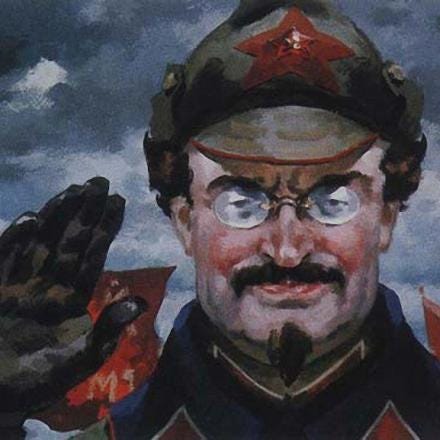
Trotsky’s account of bureaucracy has become the default lens through which much of the Left has come to understand Stalinism. He treats the bureaucracy as the central cause of the revolution’s degeneration, but does his account of its class basis and relationship to Soviet society still hold up? Indeed, the historian Robert McNeal (1977, 32) already noted in 1977 Trotsky’s “somewhat fantastic perception of the USSR in the late twenties and early Thirties,” which often served as the basis of his interpretations of the Stalinist state. Much has changed since Trotsky was writing, and new historical research into the inner workings of the Soviet system gives us good reason to be sceptical of Trotsky’s interpretation of Stalinism.
Trotsky’s hatred of the bureaucracy ran deep. Stalinism, Trotsky reasoned, did not have an organic base in the working class. It was purely a creature of the bureaucracy. Trotsky, however, is careful not to let his own animus subsume the theoretical point; Stalin was not the creator of the bureaucracy, but merely a personification of these tendencies, as the revolution had exhausted itself, leaving an opening for the bureaucratic takeover. In describing Trotsky’s characterization of the nature of Stalinism, Twiss (189, 2014) writes that:
Unlike the right and the left wings, the centrist tendency had no roots in the fundamental classes of Soviet society. Rather, [Stalinism’s] strength was to be found in the apparatuses of the party, the state, the economic institutions, and the mass organisations, which combined constituted an enormous ‘layer of “administrators”
He attributed his own political downfall to Stalin’s bureaucratic manipulation rather than to any kind of expression of meritocratic advancement or democratic sentiment within the Party. As General Secretary, Trotsky believed that Stalin used his position to build a network of loyal officials within the Party apparatus, allowing him to consolidate power and marginalize opponents through control over these appointments. In actuality, historian James Harris, working from archival evidence, argues that Stalin did not usurp power but won the support of Party officialdom through normal channels of intra-party democracy. Trotsky’s account of bureaucratic manipulation may have provided a less politically humiliating explanation for his defeat, but there is no evidence to suggest that the General Secretary’s office, despite certain advantages, possessed the autonomous, all-encompassing power often attributed to it by sections of the anti-Stalinist left, given the institutional constraints of the position. Historian James Harris (2005, 79) writes [emphasis mine]:
Some have argued that Stalin tipped the weight of the Central Committee in his favour by excluding his opponents from it and appointing his supporters. Yet there is little evidence to suggest that Stalin could control the slates of Central Committee members up for election at the Party congresses in the 1920s, or overtly manipulate its expansion in his favor. Rather, it appears as though Stalin largely carried the Central Committee on the basis of his policies and, in time, on the concrete results they brought … Stalin nevertheless placed greater emphasis on the support he had in the broader Party membership: ‘In 1927,’ he observed, ‘720,000 Party members voted for the Central Committee line. That is, the backbone of the Party voted for us
Trotsky had derided his political defeat as bureaucratic manipulation, but it is probably more accurately described as being outmaneuvered in a political struggle by a rival whose ideas and policies had greater resonance with the intended audience. A number of scholars have noted that Trotsky's single-mindedness and intransigence undermined his ability to build coalitions and navigate the cutthroat arena of Soviet politics. Trotsky, Carr (1958, 152) writes, “had no political instinct in the narrower sense, no feeling for a situation, no sensitive touch for the levers of power.” Kotkin (2014), too, reiterated Carr’s finding, largely critical of Trotsky's merits as a political operator in his monumental biography on Stalin. It’s also worth noting the extent to which Trotsky's understanding of bureaucracy was shaped by his own dwindling political prospects and alienation from the political system he played a central role in founding. Initially, from 1917-1922, Trotsky's conception of bureaucracy was centred around inefficiency and the need to restructure the Soviet economy. This was hardly unique to Trotsky, as Lenin, Stalin, and other leading Bolsheviks offered similar organizational critiques of Soviet bureaucracy, yet these earlier alternate Soviet conceptions have been overshadowed by Trotsky's later interpretation, which has come to dominate Left discussions of the Soviet bureaucratic question.
Trotsky’s recourse to bureaucracy as the master explanation for Stalinism's deficiencies carries obvious appeal, not least because it overlapped, in the wake of de-Stalinization, with right-wing anti-communist images of an omnipotent Soviet state apparatus. Yet, as we will see, Trotsky's conceptualization was quite ill-defined and vague, and lacked the rigour one might expect of Marxist analysis. Where he did take steps to outline its specific characteristics or conditions, they were often contradicted by the available evidence. Murphy (2017) writes:
Twiss contends that by 1936 Trotsky believed the bureaucracy had moved away from “relative autonomy” towards “extreme autonomy” and, claims Twiss, that this “suggested a class-like degree of autonomy.” Yet such a transformation to complete autonomy would have negated Bonapartism and represented a class, not a “class-like” formation … Either the bureaucracy was a temporary phenomenon wavering between contending classes or it represented the interests of a particular class, even if that class was the bureaucracy itself
If the bureaucracy had effectively governed as a ruling class in the process of asserting its independence, then Trotsky’s application of the Bonapartist framework, a theory premised on a class stalemate, makes even less sense. As I discussed in my earlier article on Trotsky’s interpretation of Bonapartism, Trotsky had claimed, implausibly, that Stalin was not doing enough to confront the so-called kulak threat, and that his power, in part, emerged from a stalemate between the “exploitative laters of society” and a demoralized proletariat. This balance of class forces purportedly allowed the Stalinist bureaucracy to function as a temporary mediator in a period of crisis, ruling with relative autonomy. Though as Trotsky perceived the strength and size of the bureaucracy to grow, he increasingly described it as evolving into an ever more independent and self-sustaining social formation.
Trotsky's theories of bureaucratism and Bonapartism were deeply intertwined, with Bonapartism serving as the class-structural explanation for the bureaucracy's emergence. Yet this framework sits uneasily with what the scholarship has established: the kulak, as Lewin (1966) has demonstrated, did not exist as a clearly defined class (the leadership never arrived at a clear and workable definition of what the Kulak was), and the wealthier and vocal anti-Soviet elements among the peasantry were in any case thoroughly repressed under Stalin. In the absence of evidence for an actual class stalemate, Trotsky's theorization of Bonapartism is unable to provide a coherent explanation for the emergence of the Soviet bureaucracy. And one cannot underestimate the centrality of the kulak to Trotsky’s theorizing of Bonpartism and by extension, bureaucracy, as Trotsky (1929) had written that [emphasis mine]:
The problem of Thermidor and Bonapartism is at bottom the problem of the kulak. Those who shy away from this problem, those who minimize its importance and distract attention to questions of party regime, to bureaucratism, to unfair polemical methods, and other superficial manifestations and expressions of the pressure of kulak elements upon the dictatorship of the proletariat resemble a physician who chases after symptoms while ignoring functional and organic disturbance
In addition to the Kulak problem, Trotsky repeatedly suggested that the continued growth of the bureaucracy was stoked by various alien, hostile class forces, which Stalin supposedly did not sufficiently respond to. Twiss (2014, 311) is right to point out that “this argument must have seemed less and less plausible after the leadership launched its all-out assault on the same alien elements.” Stalin's terror encompassed far-reaching, indiscriminate campaigns against entire categories of people, which included suspected class enemies alongside countless innocent people. The correct critique of Stalin was that his campaign against enemies was too extreme, not too passive. In this way, Trotsky continually misdiagnosed the issues of Stalinism, and his prescribed solution, unrelenting force against perceived state enemies, was precisely the problem to begin with. Given that his belief in Stalin’s alleged passivity towards the kulak and other domestic enemies as a driver of bureaucratic growth depended on enemies who simply did not exist on the scale Trotsky supposed, the “bureaucracy” loses its material foundation as a viable theoretical category. In light of these problems, it is difficult to see how the theory can be salvaged, and seems to suggest that Trotsky may have embraced some of the same repressive policy decisions if he had been in power instead of Stalin.
If Trotsky effectively conceded that the bureaucracy governed like a traditional ruling class by virtue of its extreme autonomy, he had moved beyond Bonapartism as Marx and Lenin conceived it—as a semi-autonomous formation contending between warring classes. This departure leaves Trotsky’s theory of the bureaucracy with more questions than answers. What was the exact nature of this independent bureaucratic ruling stratum? Generally speaking, the term “bureaucracy” implies a broad system of organization that is inherently hierarchical, and includes a spectrum of power, from lowly clerks and middle-managers to top officials. Sheila Fitzpatrick (1986, 361-362) notes that:
the social position and class interests of those at the bottom were quite different from those at the top, perhaps at times directly opposed to them. Trotsky, to be sure, had in mind the higher level of bureaucracy when he talked of a new ruling class. But how high, and on what basis can a cut-off point be drawn?
Trotsky had little to say about the class tensions and dynamics within the bureaucracy, which was certainly not a monolithic structure. An all-encompassing, amorphous “bureaucracy” tells us little about the power and class motivations of a ruling elite whose parameters cannot even be defined, or its relation to different segments within the bureaucracy which, in reality, had their own semi-independent political and economic interests. See J. Arch Getty’s Practicing Stalinism: Bolsheviks, Boyars, and the Persistence of Tradition, James Harris’ The Great Urals: regionalism and the evolution of the Soviet system, or Sheila Fitzpatrick’s Education and Social Mobility in the Soviet Union, 1921–1934 for more nuanced studies of the Stalinist state that account for the different interests within the “bureaucracy.”
The political structure of Stalinist bureaucracy was undoubtedly hierarchical, with the ruling layer occupied by Stalin and his inner circle, but Fitzpatrick(1986, 363) notes “the discovery that Stalinist society was hierarchically stratified is scarcely unexpected (what society is not?) and in itself is unlikely to change anyone’s thinking about the nature of Stalinism.” Trotsky speaks of the bureaucracy as essentially “self-sufficient,” as if the vast administrative apparatus functioned as a unified and self-directing entity ruling over a passive population (Twiss 2014, 6). Yet Trotsky was clearly oblivious to the tensions, fragmentation, and internal divisions within the Soviet state, as recent developments in Soviet historiography have made plain. The research of Adeeb Khalid and David Priestland, for instance, has revealed the ways in which the Soviet state operated as a “mobilization state,” characterized by an interplay between “above” and “below,” pursuing populist campaigns that successfully engaged ordinary citizens in state initiatives. This was not democracy in the conventional liberal parliamentary sense, but it reveals that Soviet citizens were broadly patriotic and deeply invested in the goals articulated by the Party leadership through its mass cultural and educational institutions. We see this at a more intimate level in studies of Soviet diaries and memoirs, which reveal how successfully the state drew ordinary citizens into its vision of a communist future. Hellbeck (2006, 6), whose extensive archival work has made him one of the foremost authorities on Soviet subjectivity, writes:
Through a multitude of political-education campaigns, the Soviet regime prodded individuals to consciously identify with the revolution (as interpreted by the party leadership), and thereby to comprehend themselves as active participants in the drama of history
This “mobilization state” described in the historical literature is entirely absent in Trotsky’s characterization of the state, which elides these nuances in favour of a static picture of an alienated populace, manipulated and repressed from above by a bureaucratic “ruling class,” a portrayal which was politically convenient for a disgruntled outlier looking to win back his spot in the Soviet ruling clique, but hardly reflective of how Soviet citizens actually engaged with the state. The coercive might of the USSR was certainly a defining aspect of the state, but it was only one part. It notably employed a form of what I call “pedagogical statecraft” that sought not merely to repress or manage citizens, but to transform its population through state-facilitated class struggle. Priestland (2007, 368) writes that:
As in 1928–30, Stalin was squeezing the middle-level apparatus in a ‘double press’: pressure from below was combined with pressure from above … The masses, he declared, had special energies that Bolsheviks had to use in building socialism; only ‘democratic’, non-‘bureaucratic’ relations between officials and the masses could mobilize them.
As I’ve described in detail in my other writing, the these “democratic”, populist, and anti-bureaucratic impulses lay at the heart of Stalinist terror, and, in part, explain how the leader came to endorse cataclysmic violent policies, drawing everyday citizens into the transformative class warfare which sought to usher society into the next phase of history. Priestland (2005, 183) writes that Stalin’s voluntaristic and populist tendencies “had their roots in left Bolshevik thinking.” He (2005, 183) notes that these dimensions of Stalin’s worldview “have often been obscured by the common assumption that Stalin was a conservative figure,” a popular misconception that Trotsky’s writings have contributed to. On the flip side, while Stalin’s Left or “democratic” views have been marginalized in popular historical memory, Trotsky’s conservative and centralizing tendencies have been equally obscured, buried underneath the legend of the romantic revolutionary martyr. Once both these selective readings are corrected, Trotsky’s and Stalin’s ideological worldviews are actually closer than one might think. It is worth briefly tracing out Trotsky’s ideas on democracy.
The Early Theory of Bureaucracy
